








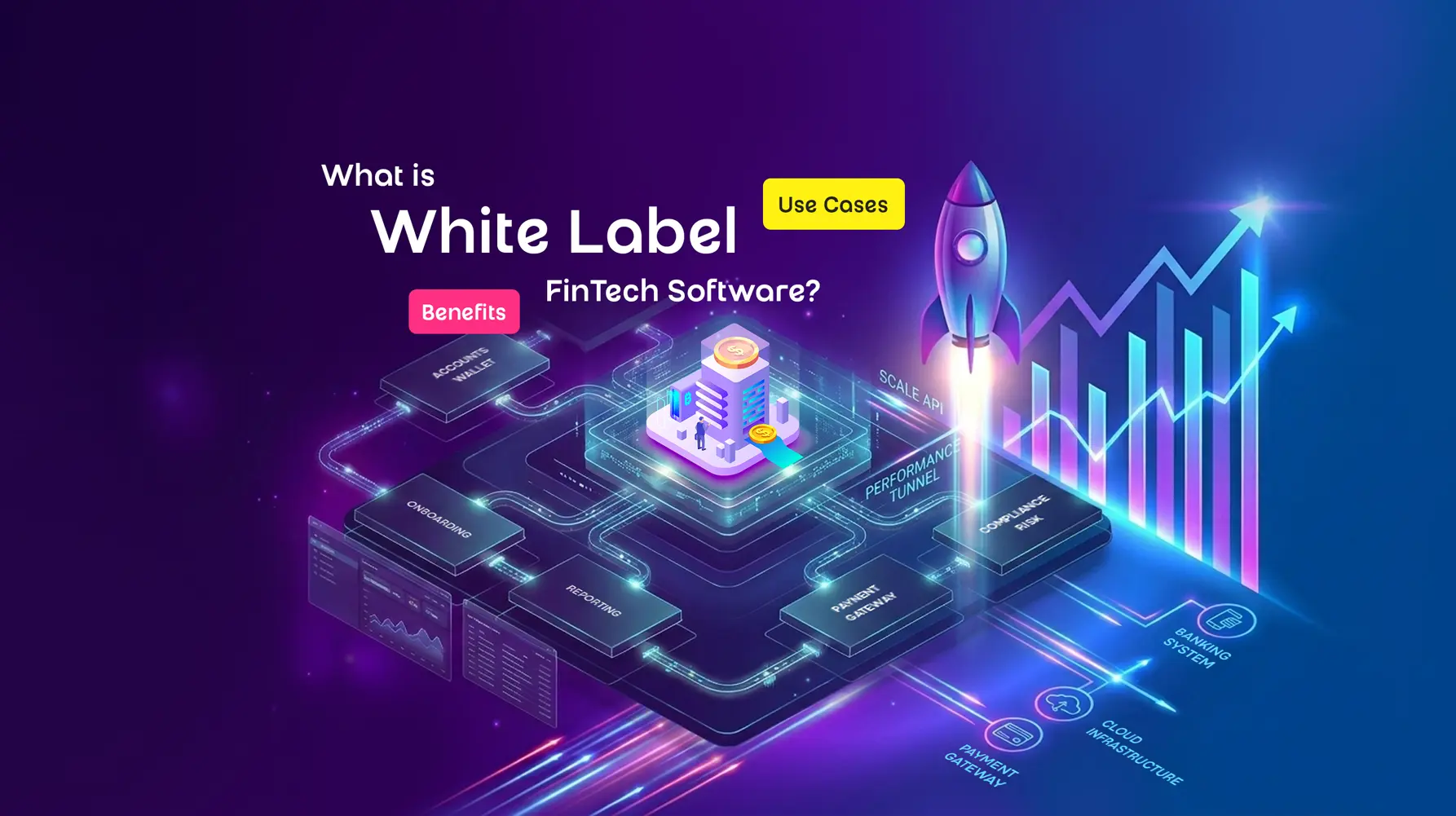
FinTech products rarely fail because the UI is ugly.
They fail because the money system behind the UI breaks: ledger edge cases, reconciliation gaps, fraud spikes, chargebacks, disputes, compliance reviews, partner outages, and support load that scales faster than your team.
That’s why white label fintech software is having a moment in 2026. It compresses build time, reduces early engineering risk, and lets you focus on the only things that actually create defensibility: distribution, pricing, partnerships, and operational discipline.
But here’s the catch: a white label fintech platform isn’t a business model. It’s an accelerator. If you buy one without a clear use case, regulatory plan, and launch process, you’ll still lose time. You’ll just lose it later.
This guide is written for:
- Startup founders shipping fast and validating demand
- Banks and financial institutions are modernizing digital offerings without a full rebuild
- Tech agencies reselling fintech and needing repeatable delivery
White Label FinTech Software Explained (What it is and how it works)
What “white label” actually means in fintech
At a simple level, a white label product is built by one company and rebranded and resold by another. CloudBlue describes a white label SaaS model as a product developed and owned by one company but rebranded and resold by another under its own brand.
In fintech terms, white label fintech software usually means you’re licensing a ready-made product layer plus a core transaction engine, then customizing:
- branding (name, logo, colors, domain)
- configuration (tiers, limits, fees, features)
- integrations (payment rails, KYC, notifications, fraud tooling)
- operations (support workflows, dispute handling, reporting)
White label fintech software vs white label fintech platform
People use these interchangeably, but the scope differs:
- White label fintech software often refers to a single module: wallet, merchant payments, cards, remittance, lending, or payouts.
- A white label fintech platform usually means a suite of modules plus shared infrastructure: admin tools, reporting, identity workflows, and an integration layer.
If you’re a bank or an agency, platforms are attractive because you can reuse the same operating system across multiple client launches. If you’re a startup, a single module can be enough for a wedge launch.
White label vs custom build vs API-first
This is the real trade-off:
- White label: fastest launch, lower build risk, bounded flexibility.
- Custom build: maximum control, slower timeline, higher total cost, and maintenance burden.
- API-first (compose from providers): flexible and modern, but requires strong engineering orchestration and a mature product team.
A practical rule: if your edge is distribution and execution, white label is usually the right early move. If your edge is proprietary risk, routing, or unique ledger behavior, you’ll feel platform limits faster.
Where the “fintech SaaS solution” fits
Most modern white label offers are delivered as a fintech SaaS solution: hosted and maintained by the vendor, with updates shipped on a release cadence. That can be great for speed, but it makes vendor due diligence and data portability non-negotiable.
What You Actually Get Under the Hood (Core components)
If you’re evaluating a white label fintech platform, don’t think “app.” Think “operating system for money.”
Here’s what you typically get.
1) Product layer (user-facing)
- Mobile apps (iOS/Android) and sometimes web
- Onboarding, login, device binding, MFA
- Transaction history, receipts, notifications
- Funding and cash-out flows (depending on rails)
- Basic support entry points
This is what most demos focus on. It’s also the least interesting part in the long term.
2) Money engine layer (ledger + transaction state)
This is the spine. You want clarity on:
- ledger behavior (available vs pending balances)
- fees and limits logic
- reversals, refunds, and dispute-related balance adjustments
- transaction state machine (initiated → pending → success/fail → reversed)
If the vendor can’t explain their ledger model in plain terms, you’re buying a problem.
3) Ops layer (admin + controls)
A mature platform includes:
- admin dashboard with role-based access control (RBAC)
- user management, limits, holds, manual review actions
- audit logs for all privileged actions
- reporting exports (transactions, settlements, fees, risk flags)
Ops tooling is what keeps you alive when something goes wrong at scale.
4) Risk and compliance hooks
White label doesn’t “solve compliance,” but it can provide hooks:
- KYC/KYB integration support
- tiered verification and limits
- monitoring triggers and rule scaffolding
- case notes and evidence trails
If you plan to ship a mobile-first product, a common security baseline teams use for mobile app verification is OWASP MASVS, which frames controls across storage, crypto, auth, network, and other mobile risk surfaces.
5) Deployment model (how it runs)
- Hosted SaaS: vendor runs it, fastest path.
- Managed hosting: vendor runs a dedicated environment for you.
- Self-hosted: less common, usually reserved for larger institutions with strict controls.
Your deployment model affects: audit scope, incident response responsibilities, and how fast you can ship changes.
How to Get the Most Out of a White Label FinTech Platform (Execution Playbook)
This is where teams either win fast or waste months.
Step 1: Start with a wedge use case (before you pick software)
White label works best when your scope is narrow and defensible.
Wedges that consistently work:
- payroll wallet for a niche workforce
- merchant-first QR acceptance for micro merchants
- marketplace payouts (seller wallets)
- remittance for one corridor
- SME collections + payouts (invoicing plus settlement)
Deliverable: 1-page wedge spec
- target user and primary job-to-be-done
- The top 3 flows you must nail
- acquisition channel (how you actually get users)
- monetization hypothesis
- compliance model (regulated vs partner)
If you can’t write this on one page, you’re not ready to choose a platform.
Step 2: Decide on your regulatory operating model early
You need clarity on “who is responsible for what” before integrations begin.
Two common approaches:
- You are the regulated entity: more control, slower timeline, heavier compliance staffing.
- You operate under a regulated partner/sponsor: faster launch, margin trade-offs, third-party dependency.
A widely used global baseline for AML/CFT expectations is the FATF Recommendations, which are regularly updated and are noted as amended in October 2025.
You don’t need to implement FATF as a checklist, but you do need a risk-based operating plan that aligns with the reality of your market and partners.
Deliverable: compliance responsibility matrix (RACI)
- Who approves KYC outcomes
- Who monitors and escalates suspicious activity
- What data is retained and for how long
- who handles disputes and chargebacks
- Who owns audit readiness
Step 3: Treat ledger and reconciliation as launch blockers
Most fintech “surprises” come from edge cases:
- funding succeeds, butthe callback arrives late
- Payout fails after the wallet was debited
- duplicate webhook events (retries)
- partial refunds
- chargeback reversals days later
- settlement timing mismatch vs what the UI shows
Deliverable: a ledger test checklist (20–30 scenarios)
Test end-to-end flows with:
- pending vs available
- idempotency rules
- reversal mechanics
- dispute adjustments
- export and reconciliation reports
If you skip this, you’ll find these issues in production when users are angry, and support is overwhelmed.
Step 4: Lock integrations before you customize UI
Teams love UI customization because it looks like progress. Integrations are where time disappears.
Minimum integration categories:
- payment rails (money-in, money-out, merchant settlement)
- identity/KYC provider
- notifications (SMS/email/push)
- analytics/event tracking
- support tooling (tickets, CRM)
- fraud signals (device, velocity, geo anomalies)
Deliverable: integration inventory
For each integration:
- native vs custom
- timeline and dependencies
- cost (setup + ongoing)
- failure handling (what happens when the provider is down)
Step 5: Define MVP scope properly (don’t overbuild)
An MVP is not a “small feature list.” It’s the smallest build that can safely run in the real world.
For most wallet-like launches, MVP includes:
- onboarding + authentication + MFA
- KYC tiering (if needed)
- money-in and money-out
- transaction history and receipts
- basic support and dispute intake
- admin controls for limits, holds, and reviews
Deliverable: MVP scope sheet
Split into:
- Phase 1 (launch)
- Phase 2 (scale features like rewards, loyalty, advanced analytics)
Step 6: Pilot launch with limits and monitoring
Fintech pilots need guardrails.
Pilot strategy:
- limited cohort
- conservative limits
- narrow geography or merchant category
- daily monitoring cadence
Core pilot KPIs:
- activation rate (from signup to first successful transaction)
- KYC completion rate
- payment success rate
- dispute rate
- fraud loss percentage
- support tickets per 1,000 users
Deliverable: pilot scorecard
If you can’t measure these, you can’t control risk.
Step 7: Scale with thresholds, not vibes
Scaling should be conditional.
Examples of scale thresholds:
- Expand limits only after the dispute rate stays below X for Y weeks
- Expand regions only after reconciliation variance stays near zero for Y weeks
- Expand marketing only after the payment success rate stays above X
Deliverable: scaling checklist
This turns “growth” into an operational system.
Cost Breakdown: What It Really Costs to Launch and Operate
People ask for a number. The better answer is a cost map.
Cost buckets you must budget for
- Platform license/setup
- Integrations
- payment rails, KYC, notifications, fraud tooling
- Hosting and monitoring
- Compliance operations
- people, tooling, audits, reporting workflows
- Security and testing
- pen tests, secure SDLC, mobile security verification
- Support + disputes
- Marketing and distribution
- merchant acquisition, partnerships, referral programs
White label vs custom build cost reality
Custom builds often start cheap on paper and inflate later because:
- compliance requirements evolve
- security standards tighten
- Operational tooling becomes mandatory
- Maintenance never stops
If you handle cardholder data, the PCI DSS scope can matter. Many industry resources emphasize that the March 31, 2025, effective date for new PCI DSS v4 requirements remains a key date, influencing ongoing security work for in-scope organizations.
A smart early-stage budget move is to spend less on “extra features” and more on:
- compliance readiness
- distribution
- reconciliation reliability
- support operations
That’s what keeps you alive.
Choosing the Right Approach and Vendor (Decision Framework)
When white label is the right move
White label fintech software is usually the best choice when:
- You need speed-to-market
- You’re validating a niche
- Your edge is distribution, not infrastructure
- You’re launching one region at a time
- You need a repeatable delivery model (banks and agencies love this)
When white label is the wrong move
Avoid white label if:
- Your edge is proprietary risk scoring or routing
- You need a custom ledger behavior as a differentiator
- You’re launching across many jurisdictions immediately
- Vendor dependency creates unacceptable business risk
- You cannot get data portability and clean export guarantees
The “no-regrets” decision test
Ask: “If this vendor disappeared in 12 months, could we migrate without losing the business?”
If the answer is no, negotiate better terms or pick another platform.
Final Takeaway and Next Steps
White label fintech software is an accelerator. Not a shortcut.
If you want the benefits without the blow-ups, focus on five things:
- narrow wedge use case
- clear regulatory operating model
- ledger and reconciliation discipline
- unit economics that include ops and fraud
- A distribution strategy built alongside the product scope
If you’re actively evaluating a white label fintech platform, the fastest way to reduce launch risk is a pre-purchase vendor scorecard: money-flow mapping, integration inventory, ledger test scenarios, and data portability checks.
If you want, tell me your target product (wallet, merchant QR, cards, payouts, remittance) and your target market. I’ll produce a vendor scorecard template tailored to your use case and the exact MVP scope you should launch with first.