








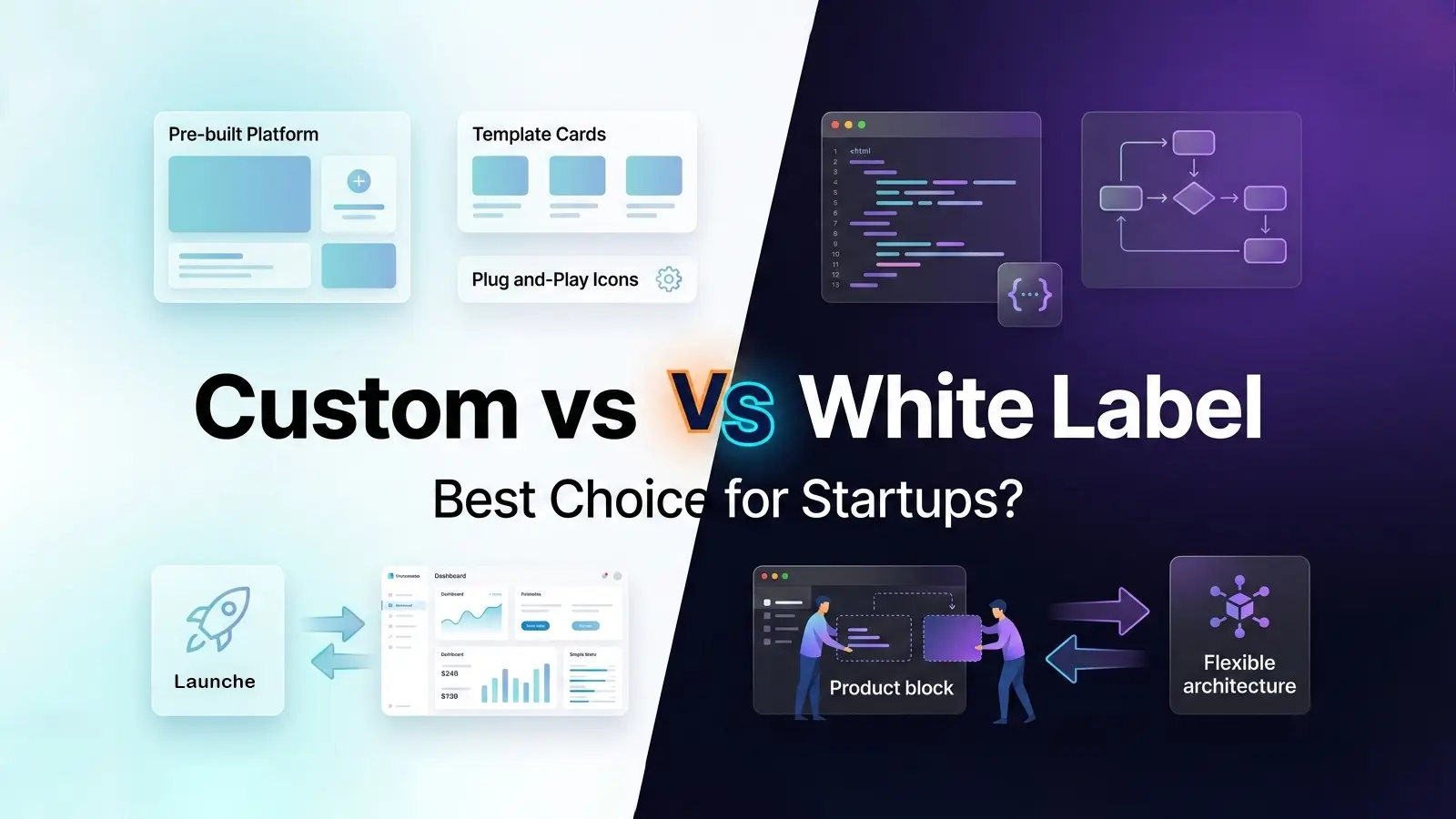
Choosing between white label vs custom software is one of the most important decisions a startup will make when building a digital product. The choice affects development cost, launch speed, scalability, and long-term product flexibility.
Startups today are under pressure to launch quickly while still building products that can scale. Some teams choose white label software to enter the market faster, while others invest in custom development to build something completely unique.
Many founders exploring this decision are building fintech or payment products where choosing the right architecture early can significantly reduce technical risk. Companies offering fintech software solutions often see startups struggling with this same trade-off between speed and flexibility.
This guide explains the real differences between custom software and white label solutions, when each approach makes sense for startups, and how to decide which option fits your business model.
What White Label and Custom Software Actually Mean
White label software is a pre-built product you can rebrand and configure. You are typically buying speed, operational maturity, and predictable workflows, with limits on how far you can change the core product.
Custom software is built specifically for your requirements. You gain maximum flexibility and ownership, but you also inherit build time, maintenance, security obligations, and team complexity.
Key differences at a glance:
- White label: faster launch, lower initial engineering risk, bounded flexibility.
- Custom: slower launch, higher upfront cost, full control, and long-term ownership.
- SaaS vs custom: SaaS describes how software is delivered/hosted. Custom describes how software is built. You can have “custom SaaS” or “white label SaaS.”
White Label vs Custom Software
Below is a practical comparison startups often use when evaluating both options.
| Factor | White Label Software | Custom Software |
|---|---|---|
| Time to launch | Fast | Slower |
| Development cost | Lower | Higher |
| Flexibility | Limited | Fully customizable |
| Maintenance | Mostly vendor managed | Fully managed by your team |
| Scalability | Depends on vendor | Fully controlled |
While white-label products accelerate product launches, custom platforms give startups more control over product differentiation.
Where “Custom Software Development vs SaaS” Fits
Startups often treat “SaaS” as the opposite of “custom.” It is not. SaaS is a hosting/delivery model. Custom is a build approach.
Here is the clean way to think about it:
- White label SaaS: vendor hosts and maintains; you configure and brand.
- White label self-hosted: rarer; you run it, and the vendor provides the software.
- Custom SaaS: You build and operate the software; highest control, highest responsibility.
This matters because a startup’s ability to operate infrastructure and security often determines whether “custom” is realistic early.
When White Label Software Is Usually Better for Startups
White label software is often the right choice for early-stage startups that want to validate their business model quickly.
Launching a product fast can be critical for testing market demand and building early traction. Instead of spending months developing infrastructure, startups can use a ready-made solution and focus on marketing, partnerships, and customer acquisition.
For example, many fintech startups launch products using white label digital wallet software instead of building a full payment infrastructure from scratch. This approach reduces development complexity while still allowing companies to bring financial services to market quickly.
White label usually wins when
- You need to ship in weeks, not months.
- Your initial workflow is standard for the category.
- You want to reduce early engineering risk and focus on go-to-market.
- You can differentiate through distribution, partnerships, and execution.
- Compliance, reporting, or operational tooling is heavy, and you do not want to reinvent it.
The biggest benefit is not “cheap software.” The biggest benefit is that you can validate demand without overbuilding infrastructure that you might later replace.
When Custom Software Is Usually Better for Startups
Custom development becomes valuable when the product itself is the company’s competitive advantage.
Some startups rely heavily on unique workflows, proprietary algorithms, or complex integrations that pre-built platforms cannot easily support. In these cases, building a custom system may be necessary.
Startups typically choose custom development when:
- Their product requires unique functionality
- Deep integrations with external systems are required
- Data ownership and infrastructure control are critical
- Long-term product differentiation is important
In many situations, companies partner with a fintech software development company to build custom platforms designed around their specific business model and technical requirements.
Although custom development requires more time and investment, it gives startups full ownership of the product architecture.
Comparing White Label vs Custom
Use this table for internal alignment.
| Dimension | White label software | Custom software |
|---|---|---|
| Launch speed | Fast | Slower |
| Upfront cost | Lower | Higher |
| Flexibility | Limited to vendor design | Full control |
| Differentiation | Mostly GTM + configuration | Deep product differentiation |
| Maintenance | Vendor-heavy (if SaaS) | You own everything |
| Security/compliance work | Often shared/managed | You carry primary responsibility |
| Integrations | Within vendor boundaries | Unlimited (but you build it) |
| Lock-in risk | Medium to high | Low (you own codebase) |
| Long-term TCO | Lower early, may rise | Higher early, can stabilize |
The Hidden Costs Startups Usually Miss
Many founders focus only on the initial development cost when comparing white label and custom software. However, the real cost of software includes long-term maintenance, operational overhead, and infrastructure management.
Hidden costs of white label software
- Vendor dependency
- Limited customization
- Additional fees for advanced features
- Migration complexity if switching platforms later
Hidden costs of custom development
- Ongoing maintenance and security updates
- Engineering team costs
- Infrastructure and hosting expenses
- Longer product development cycles
Understanding these hidden costs helps startups make more realistic decisions when comparing white label vs custom software.
A Startup-Friendly Decision Framework
If you want to decide quickly, use these five questions. They create clarity without long debates.
1) What are you proving in the next 90–180 days?
- Product-market fit and activation?
- Pricing and packaging?
- Distribution and partnerships?
- Compliance readiness?
If the goal is validation, white label often makes more sense early.
2) What must you control on day one?
Write your non-negotiables:
- Data model ownership
- Critical integrations (ERP, payments, identity)
- Pricing logic and billing
- Security posture and auditability
- Workflow uniqueness and automation
- Enterprise requirements (RBAC, multi-tenancy, audit logs)
If you cannot express these through vendor configuration, custom becomes more compelling.
3) How fast do you need to launch?
- Partner deadline
- Investor milestone
- Seasonal demand
- Competitive window
When the timeline is non-negotiable, white label is usually the practical choice.
4) What is your real budget, including operations?
Budget includes more than development:
- support
- monitoring
- compliance operations
- incident response
- Ongoing QA and security work
Custom requires higher operational maturity, not just more money.
5) What is your exit plan if you choose white label?
Even if you never migrate, plan as if you might:
- data exports and portability
- identity/auth migration approach
- What you can rebuild later without breaking customers
No exit plan is a lock-in plan.
A Practical Hybrid Strategy Many Startups Use
Interestingly, many successful startups do not choose only one approach. Instead, they use a hybrid strategy.
In the early stage, companies may launch their product using white label infrastructure to validate demand and reduce development risk. Once the product gains traction, they gradually replace parts of the system with custom components.
For example, a fintech startup might begin with a card issuing solution to launch quickly. As the product grows, the company may build its own transaction logic, analytics systems, or integrations to create deeper differentiation.
This phased approach allows startups to balance speed and flexibility without overinvesting too early.
What to Evaluate Before Choosing White Label
Focus less on feature count and more on operational reality.
White label evaluation checklist:
- Workflow fit: Does it match your wedge without awkward workarounds?
- Extensibility: APIs/webhooks and integration surface quality.
- Data portability: clean exports for users, transactions, logs, and configurations.
- Reliability: uptime expectations and incident process.
- Security: access controls, audit logs, vendor security posture.
- Commercials: predictable pricing as you scale, clear add-on costs.
White label can be a strong move, but only if the vendor is stable and the product boundary matches your business.
What to Evaluate Before Choosing Custom
Custom is not “build whatever you want.” It is “operate what you build.”
Custom readiness checklist:
- Clear architecture plan (data model, identity, integrations).
- Ownership of security posture and secure development practices.
- Monitoring, logging, and incident response capability.
- A team that can maintain and evolve the system, not just launch it.
- A roadmap tied to proven customer needs, not assumptions.
If these are missing, custom builds often slip in the timeline and degrade in quality.
Common Startup Mistakes in This Decision
These patterns cause the most rework.
- Choosing custom because it feels “serious,” not because it is necessary.
- Choosing white label with no data portability or exit plan.
- Underestimating operational requirements (support, monitoring, compliance).
- Over-optimizing for cost instead of learning speed and iteration capacity.
A good decision is not the cheapest. It is the one that keeps your learning curve steep and your risk controlled.
Conclusion
The right answer to white label vs custom software depends on what you are trying to achieve now and what you need to own later.
White label is usually better when speed, validation, and standard workflows matter most. Custom is usually better when your differentiation requires unique workflows, deep integrations, and long-term control, and when your team can operate the system reliably.
A practical default for many startups is hybrid: validate with white label, then invest in custom where it creates real differentiation.
If you tell me your category (fintech, marketplace, SaaS, healthcare), your go-live window, and your “must-control” list, I can recommend the better path and what to validate first.