








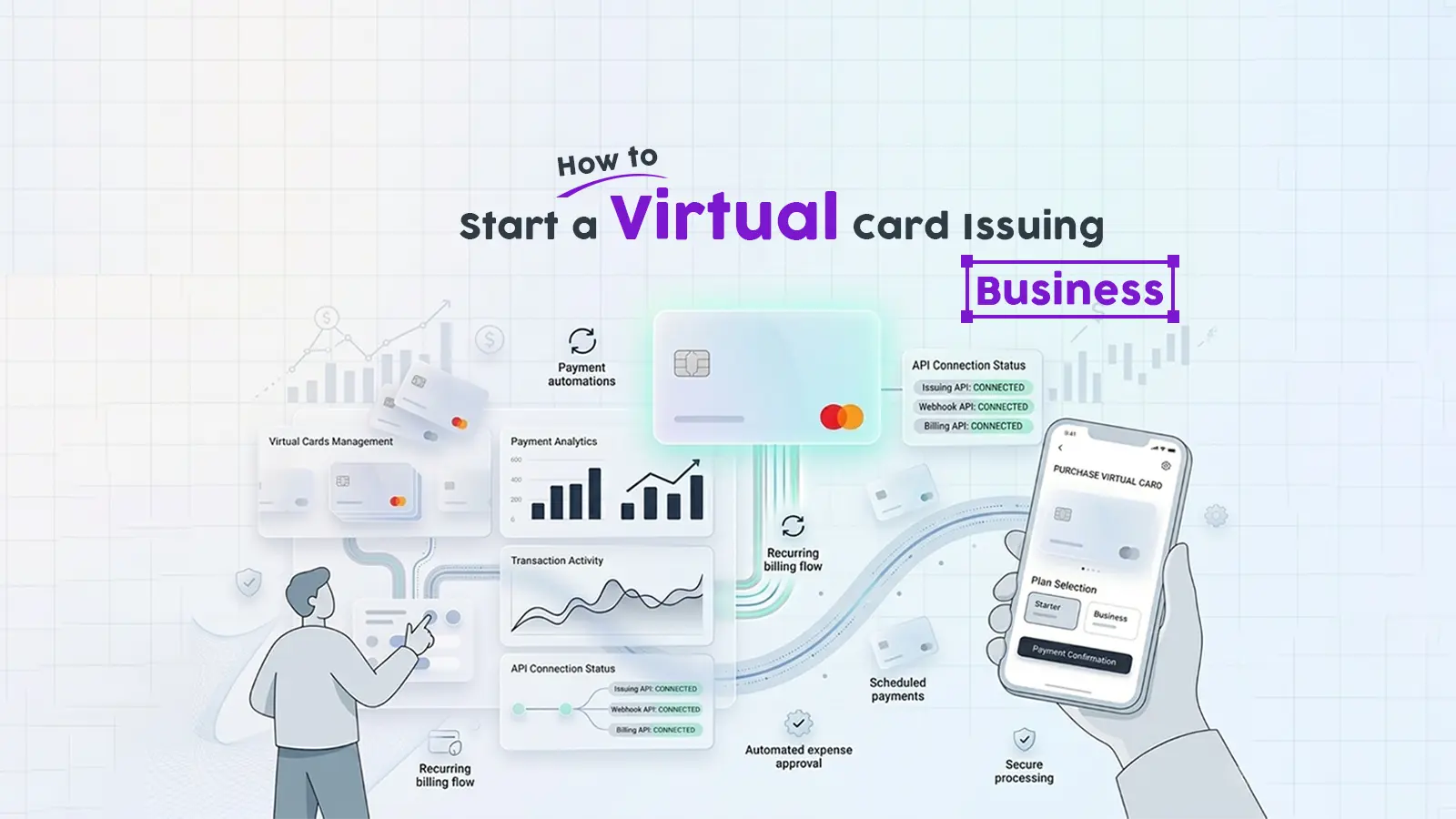
Launching a virtual card issuing business is no longer reserved for banks or large fintech. Today, many teams start with virtual card issuing software and a proven card issuing platform, then differentiate through controls, reporting, workflows, and distribution.
What makes this business attractive is not the card number itself. It is the ability to issue cards instantly, restrict how they can be used, and generate accounting-grade reporting that finance teams can trust. For developers and integrators, the success of the product depends on whether the virtual card API and events behave consistently under real-world conditions like retries, delayed status updates, and edge-case declines.
This guide explains how virtual card issuing works, what infrastructure is required, the compliance and security considerations to plan for, how to structure your technical setup without going overly technical, and how virtual card issuers monetize sustainably.
What Is a Virtual Card Issuing Business?
A virtual card issuing business enables businesses to create and manage payment cards digitally, usually for controlled spending. Virtual cards can be issued instantly and governed with rules such as transaction limits, time-based expiry, and merchant or category restrictions. In most programs, these cards are used in B2B workflows where traceability and reconciliation matter more than consumer-style rewards.
Virtual cards differ from physical cards mainly in delivery and control. There is no physical plastic to manufacture or ship, and the card can be generated on demand for a specific purpose. This makes them ideal for invoice payments, procurement, team spends management, and embedded use cases where you want to tightly define “what this card can do” before it is ever used.
Common Use Cases for Virtual Cards
Virtual cards tend to succeed when you can connect the card to a predictable workflow and attach clear references for reconciliation. Common examples include:
- Expense management platforms issuing employee or team spend cards
- Online advertising payments with strict campaign budgets
- Travel and field operations with trip-based limits and expiry windows
- SaaS and IT procurement where vendor controls reduce misuse
- B2B payment automation (one card per invoice or per vendor)
How Virtual Card Issuing Works (High-Level Architecture)
A virtual card product is typically built on a partner ecosystem. Even when your brand is on the product, the issuing stack includes several layers that have different responsibilities.
At a high level, a virtual card issuing program involves:
- A card network layer (card acceptance rules and routing)
- An issuing bank or sponsor layer (issuer-of-record and program oversight)
- A processing layer (the card issuing platform that creates cards and handles authorizations)
- An integration layer (the virtual card API and event/webhook model)
- Your product and operations layer (customer workflows, controls, reporting, support, risk operations)
The key planning point is this: your customers do not care about the network or processor brand. They care that cards are issued instantly, controls are enforceable, declines are explainable, and reporting exports match what accounting expects.
Key Players in the Card Issuing Ecosystem
The issuing bank (or sponsor) typically provides program oversight and enables access to the issuing rails under its regulated framework. The issuing processor or card issuing platform provides the technical capability to issue cards, process authorizations, manage card lifecycle states, and expose APIs and event notifications.
Your business often acts as the program manager in practice. That means you design the product, acquire customers, decide which controls exist, create reporting that makes reconciliation possible, and operate the support and exception workflows. This is why “virtual card issuing” is not only a technical launch. It is also an operational launch.
Business Models for Virtual Card Issuers
Virtual card issuing becomes sustainable when it is anchored to an ongoing business workflow. Cards issued sporadically do not create enough volume or retention to justify the program overhead. The strongest businesses either own distribution or embed issuance into an existing workflow with repeat usage.
Revenue Streams
Most issuers monetize through a combination of these levers:
- Subscription or SaaS fees (tiered plans, per-seat pricing)
- Platform fees (module-based pricing for controls, reporting, permissions)
- Transaction-related fees (issuance fees, authorization/usage-based pricing)
- Interchange-related revenue share (where applicable)
- FX or cross-border margin (if multi-currency is supported)
A practical pricing rule is to charge for outcomes: better control, fewer errors, faster reconciliation, and reduced support load. If you price only on transactions, you risk competing on commodity economics rather than value.
Common Business Models
Expense management platforms are a common model because business spend happens continuously and can be governed with policy controls. Procurement and AP-focused products also perform well because virtual cards map naturally to invoices and purchase orders, which makes reconciliation compelling.
Embedded issuing inside platforms can be even stronger, because distribution is already present. Marketplaces, vertical SaaS products, and operational platforms can issue cards inside the workflow and control how spend happens. The platform becomes the acquisition channel, which reduces the biggest risk for new issuers: “We built it, but nobody uses it.”
How to Start a Virtual Card Issuing Business
This is the core launch sequence that reduces time-to-market while keeping operational risk under control.
Step 1: Define Your Target Market
Start with a narrow wedge. Your first version should be built for one clear job-to-be-done, not “a card product for every business.” A focused use case makes it easier to set controls, produce the right reporting, and build a sales narrative that lands with a specific buyer.
Good starting wedges include SMB expense control, travel spend, SaaS procurement, advertising spend management, or invoice-based B2B payments. The wedge is less about the industry name and more about the workflow structure. If you can attach references like invoice ID, PO number, cost center, or campaign budget, you can deliver immediate reporting value.
Before choosing partners, write a one-page scope:
- Who is the buyer (finance, procurement, ops, platform owner)?
- What is the recurring workflow?
- What control rules are required?
- What reporting exports must exist on day one?
- What integrations are required in phase one vs later phases?
Step 2: Choose an Issuing Partner or Sponsor Bank
Most new programs launch under an issuing partner model. This provides a compliant path to issue cards without trying to become an issuer-of-record immediately. What matters most is not only the partner’s capability, but clarity on responsibilities.
You should define who owns: onboarding requirements (KYB/KYC where relevant), risk monitoring expectations, dispute workflows, and how reporting and settlement are delivered. Teams often lose months because they select a partner without mapping the operational responsibilities.
A smart early step is to ask for a program approval checklist and a realistic timeline. Also ask how changes happen after launch: new control types, new customer tiers, new reporting requirements, and how quickly the partner supports those changes.
Step 3: Select a Card Issuing Platform
Your card issuing platform is the engine that makes virtual card issuance real. It must support card lifecycle management, authorization behavior, controls, reporting exports, and predictable events. If the platform is weak on reporting or event reliability, your support team will absorb the cost.
If you want a practical benchmark for what a complete Virtual Card Issuing Solution typically includes (controls, reporting, security, and admin tooling), this overview is a useful reference.
When evaluating platforms, keep the focus on operational reality: can you explain declines, can you prevent duplicates, can finance reconcile transactions to settlement exports, and can you enforce controls reliably.
This is where virtual card issuing software matters most: a strong platform reduces build complexity and lets you invest in product differentiation rather than rebuilding issuing plumbing.
Step 4: Integrate a Virtual Card API
This is the integration surface. Even if your product is non-technical, your system must behave predictably for integrators and internal engineering teams.
At a minimum, the virtual card API should support:
- creating cards programmatically and attaching a business reference (invoice, vendor, cost center)
- setting and updating controls (limits, expiry windows, merchant/category restrictions)
- receiving status updates through events/webhooks
- safe retry behavior to avoid duplicate cards and inconsistent state
For developers, the most important questions are usually not “can I create a card?” but “what happens during retries,” “how do I correlate transactions to references,” and “how do I handle pending or partial states without confusing users.”
Step 5: Implement Compliance and Security
Keep this global and practical. Requirements vary depending on partners and jurisdictions, but the operational expectation is consistent: manage risk, apply controls, and maintain auditability.
At a high level, plan for KYB/KYC (as applicable), risk-based monitoring, tiered limits, and fraud prevention controls. From a security standpoint, you must protect administrative access, maintain logs for sensitive actions, and minimize unnecessary exposure to sensitive card data.
A useful framing for teams is: compliance shapes the product. It affects onboarding UX, limit rules, support workflows, and reporting retention. If you treat it as paperwork, you will rebuild later.
Step 6: Design the User Experience
The best virtual card products are designed for finance teams, not just for “issuing cards.” That means the dashboard and reporting experience must be as strong as the issuance experience.
A solid first version should allow users to issue cards, set controls, and track activity without confusion. It should also support organizational needs, including roles and permissions, relevant approval flows, and exports that meet accounting expectations. If the product cannot explain “why it declined” or cannot export clean transaction references, adoption will stall even if issuance works technically.
Step 7: Launch and Scale
Launch with a controlled pilot. Your first goal is stability and learning, not maximum growth. You want to know what declines look like, where users make mistakes, and whether the reporting matches finance expectations.
A pilot should include:
- a limited cohort of early customers
- conservative limits and control rules
- a clear exception workflow for declines and disputes
- weekly reconciliation using settlement and transaction exports
Once stability is proven, scale by adding integrations, expanding customer tiers, and broadening controls and reporting features.
Key Features to Look for in Virtual Card Issuing Software
This is the section buyers will scan. Keep it oriented around outcomes and operational reliability.
A strong virtual card issuing software stack should include:
- Instant card issuance with clear lifecycle states (active, paused, closed)
- Controls: limits, expiry windows, merchant locks, and category restrictions
- Predictable authorization behavior with clear decline reasons
- Reliable events/webhooks with safe retries and idempotency guidance
- Reporting exports that include references (invoice ID, cost center, vendor)
- Admin access controls (RBAC) and audit logs for sensitive actions
- Clear representation of refunds, reversals, and disputes in reporting
Virtual Card API: What Developers Should Know
Developers care about consistency more than features. A virtual card API is valuable when it behaves predictably under real conditions.
At a practical level, your API and events model should make it easy to:
- issue cards and attach business references
- update controls without breaking downstream reporting
- Receive authorization and transaction events reliably
- Reconcile events and transactions to settlement outputs
- handle retries without duplicate card creation
This is also where good documentation matters. Clear examples, consistent terminology, and an honest description of edge cases will reduce integration friction and support load.
Security and Fraud Prevention for Virtual Cards
Virtual cards can reduce risk compared to shared corporate cards because they are easier to control and rotate. The risk model improves significantly when you use controls that align with the workflow: single-use cards for invoices, merchant locks for vendor payments, and time windows for short-lived spend.
Practical anti-fraud controls include spend limits, merchant/category restrictions, velocity monitoring, and an exception queue for unusual patterns. Security is also administrative: enforce MFA for admins, segment permissions, and log sensitive changes. These measures are often the difference between a scalable program and a program that becomes fragile under growth.
Costs Involved in Launching a Virtual Card Program
Avoid exact numbers in a public guide. Costs vary by partners, regions, and volume. What matters is understanding the categories so you can budget realistically.
Typical cost buckets include:
- issuing partner/sponsor program costs
- card issuing platform fees (issuance, authorization, usage, reporting)
- compliance and security operations
- support and dispute-handling overhead
- integrations and ongoing maintenance
- fraud monitoring and exception handling
The most overlooked cost is operational. If your reporting is weak or the reasons are unclear, support costs rise quickly, and margins compress.
Common Challenges When Starting a Card Issuing Business
1) Regulatory and partner timelines are often slower than founders expect. Mitigate this by keeping the initial scope narrow, providing clear policy and control definitions early, and running a disciplined approval process.
2) Integration edge cases can create a real support load. Delayed events, retries, and inconsistent status mapping cause duplicates and confusion. Mitigation requires idempotency, clear retry rules, and failure-path testing.
3) Fraud and misuse patterns evolve as volume grows. Controls must be paired with monitoring and exception workflows. A pure “rules-only” approach without an operational review path often fails at scale.
4) Onboarding friction can reduce activation. Business onboarding should be risk-tiered so you can start customers small, then expand limits as trust is established.
5) Reconciliation mismatches are the fastest way to lose financial trust. Mitigation is simple: enforce reference capture at issuance and ensure exports include those references consistently.
Troubleshooting table
| Symptom | Likely cause | Practical fix |
|---|---|---|
| High decline rate | controls too strict, category mismatch, wrong merchant lock | adjust rules, improve decline reason mapping, add admin override flow |
| Duplicate cards created | retries without idempotency | implement idempotency keys and safe retry logic |
| Finance cannot reconcile spend | missing references or weak exports | require invoice/cost center references; improve export fields |
| “Random” declines | unclear decline reason taxonomy | standardize decline reasons; expose them in dashboard |
| Support overwhelmed | no exception workflow | build exception queues + templates + escalation rules |
Choosing the Right Card Issuing Platform
Selecting the right platform is less about a long feature list and more about whether the system behaves predictably. During vendor evaluation, prioritize evidence: sandbox behavior, reporting exports, and event reliability.
Key criteria to evaluate:
- API reliability and sandbox testing quality
- Documentation clarity for developers and integrators
- Controls coverage (limits, merchant/category restrictions, expiry windows)
- Webhook/event delivery reliability and retry rules
- Reporting and reconciliation exports aligned to finance needs
- Dispute/refund representation and ownership clarity
- Scalability, uptime transparency, and incident handling
- Support responsiveness for integration and operational issues
A helpful demo approach is to ask vendors to “show, not tell.” Ask them to demonstrate a decline reason end-to-end, export settlement reporting, configure a merchant lock, and explain how retries prevent duplicates.
Future of Virtual Card Issuing
Virtual card issuing is expanding because businesses want controlled, automated payments that integrate into existing workflows. Embedded finance growth and B2B automation trends are pushing more platforms to offer issuing capabilities as a feature rather than a standalone product. The practical direction is clear: more API-driven issuing stacks, more automation in reconciliation, and stronger demand for governance and auditability in business spend.
Conclusion
Starting a virtual card issuing business is now feasible because partners and platforms handle much of the heavy infrastructure. Your job is to build a product that businesses trust: strong controls, predictable authorization behavior, finance-grade reporting, and disciplined operations.
If you want the fastest, safest launch path: pick a narrow wedge, partner for issuance, use proven virtual card issuing software, and prioritize reporting and exception handling early. That is what turns “virtual cards” into a real business rather than a short-lived feature.